Showing every subjectChange subjects

0625/03/SP/23 · question 2 of 3 in this topic

Question 2

2(a)2 marks

A piece of metal has an irregular shape. The weight of the metal is 3.0 N.

Calculate the mass of the metal. (Take the weight of 1.0 kg to be 9.8 N.)

Calculate Show your working. The method can earn marks even when the final value is wrong, and a bare answer often cannot.

Your answer

Suggested time: 3 min
2(b)(i)4 marks

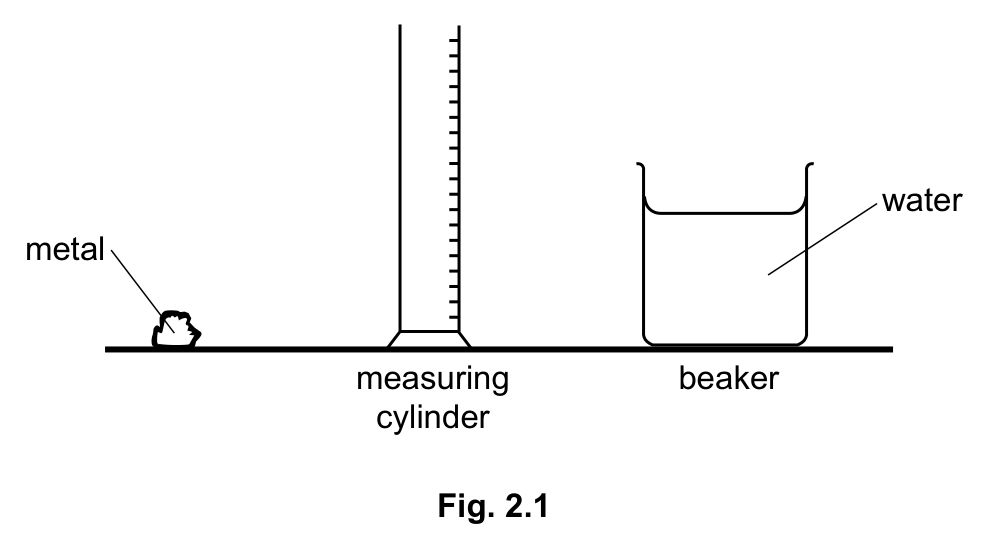
A piece of metal has an irregular shape. Fig. 2.1 shows the piece of metal, a measuring cylinder and a beaker containing water.

Describe how to determine the volume of the piece of metal, using the equipment in Fig. 2.1.

Fig. 2.1 — see the question text for what it shows

Describe Say what happens, in order. Reasons are not required unless the question also asks why.

Your answer

Suggested time: 6 min

2(b)(ii)1 mark

A method of finding the volume of an irregularly shaped piece of metal uses a measuring cylinder and a beaker of water (displacement of water).

Explain why this procedure is not suitable for finding the volume of a piece of low-density wood that is a similar shape and size to the piece of metal.

Explain Give reasons, not just what happens. Each distinct reason is usually worth a mark.

Your answer

Suggested time: 2 min

2(b)(iii)3 marks

The mass of another piece of metal is 405 g and its volume is 150 cm³.

Calculate the density of this piece of metal, in g/cm³.

Calculate Show your working. The method can earn marks even when the final value is wrong, and a bare answer often cannot.

Your answer

Suggested time: 5 min

0625/03/SP/23Cambridge IGCSE Physics 0625 · Specimen 2023 · Paper 3 · sit the whole paper