State what is meant by resonance.
State A short answer. No explanation is needed, and adding one cannot earn extra marks.
Your answer
Suggested time: 3 min
9702/41/M/J/24 · question 1 of 2 in this topic
State what is meant by resonance.
State A short answer. No explanation is needed, and adding one cannot earn extra marks.
Your answer
Suggested time: 3 min
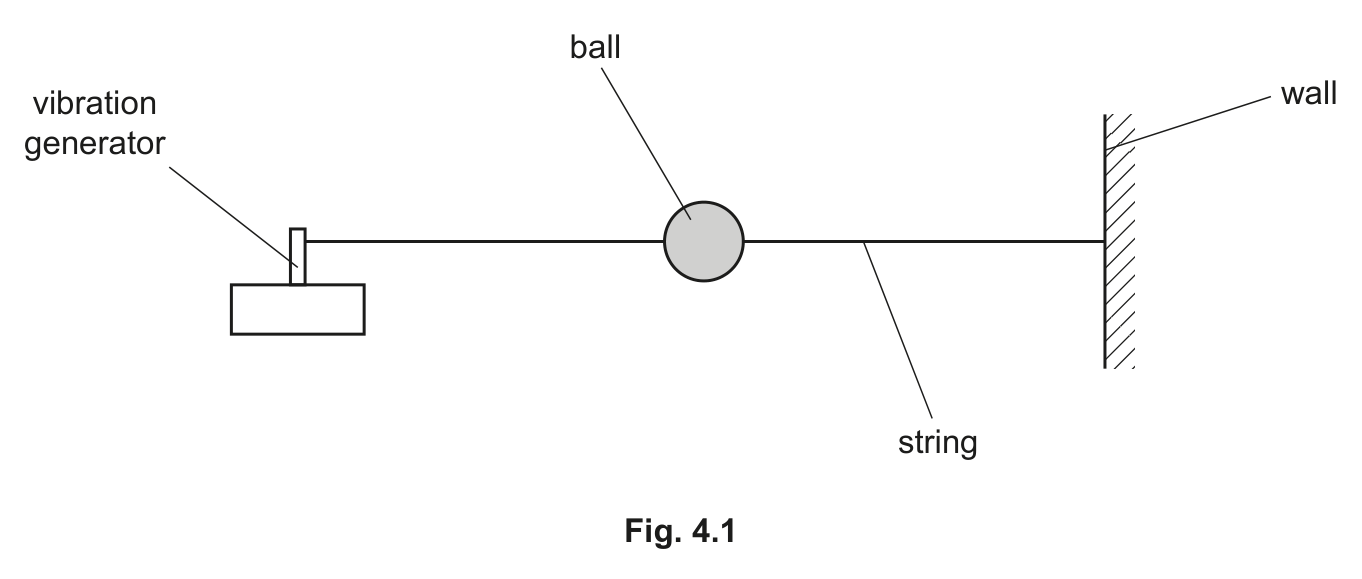
A small ball is held in place using a stretched string. One end of the string is fixed to a wall and the other end is attached to a vibration generator . Initially, the vibration generator is switched off. A student displaces the ball vertically and then releases it.
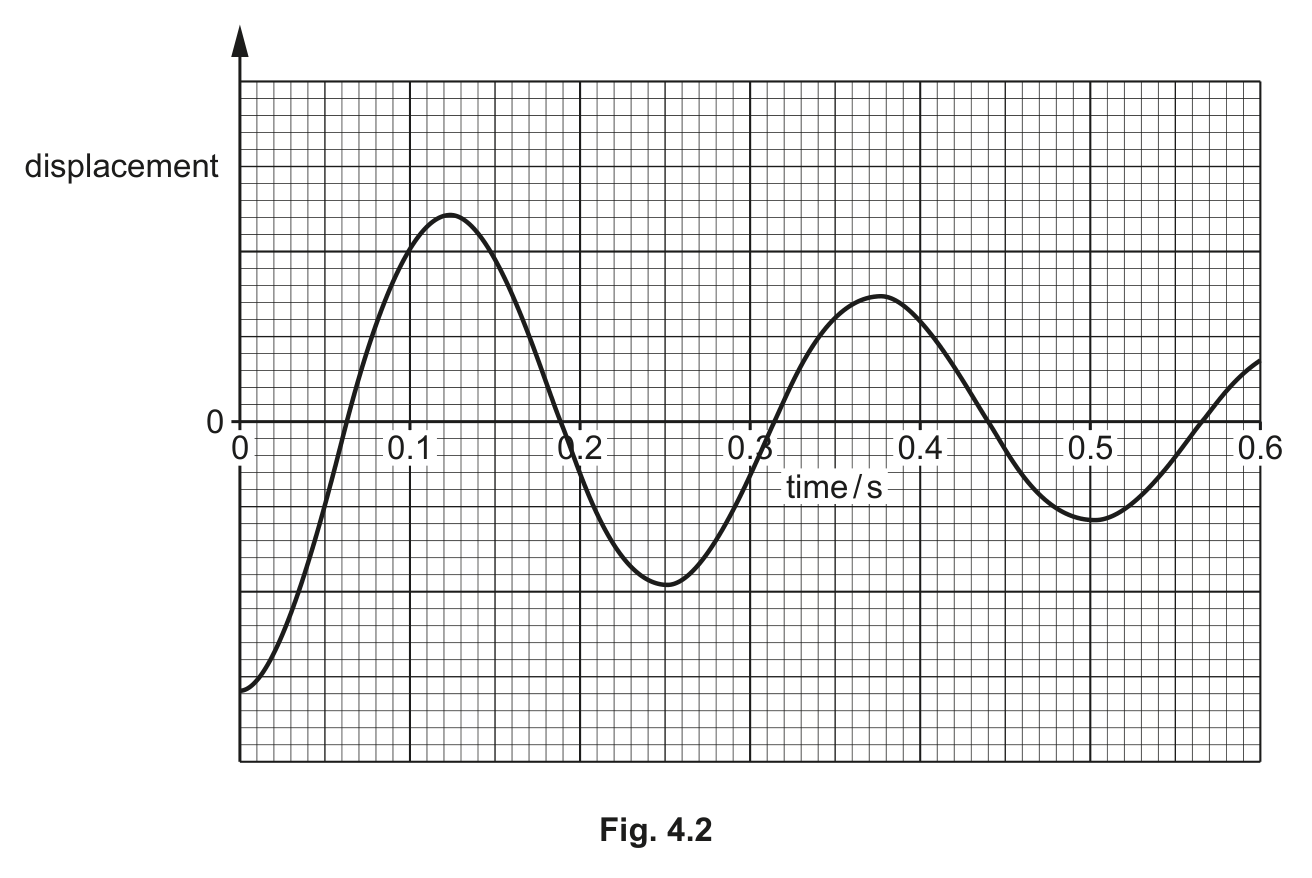
State the name of the phenomenon illustrated by the decrease in the amplitude of the oscillations in Fig. 4.2.
State A short answer. No explanation is needed, and adding one cannot earn extra marks.
Your answer
Suggested time: 2 min
A small ball on a stretched string is displaced vertically and released; the vibration generator attached to one end of the string is switched off.
Explain the decrease with time of the amplitude of the oscillations of the ball.
Explain Give reasons, not just what happens. Each distinct reason is usually worth a mark.
Your answer
Suggested time: 3 min
A small ball on a stretched string is displaced vertically and released.
Determine the frequency of the oscillations of the ball.
Determine Work it out from what you are given or from the figure, and show how you got there.
Your answer
Suggested time: 2 min
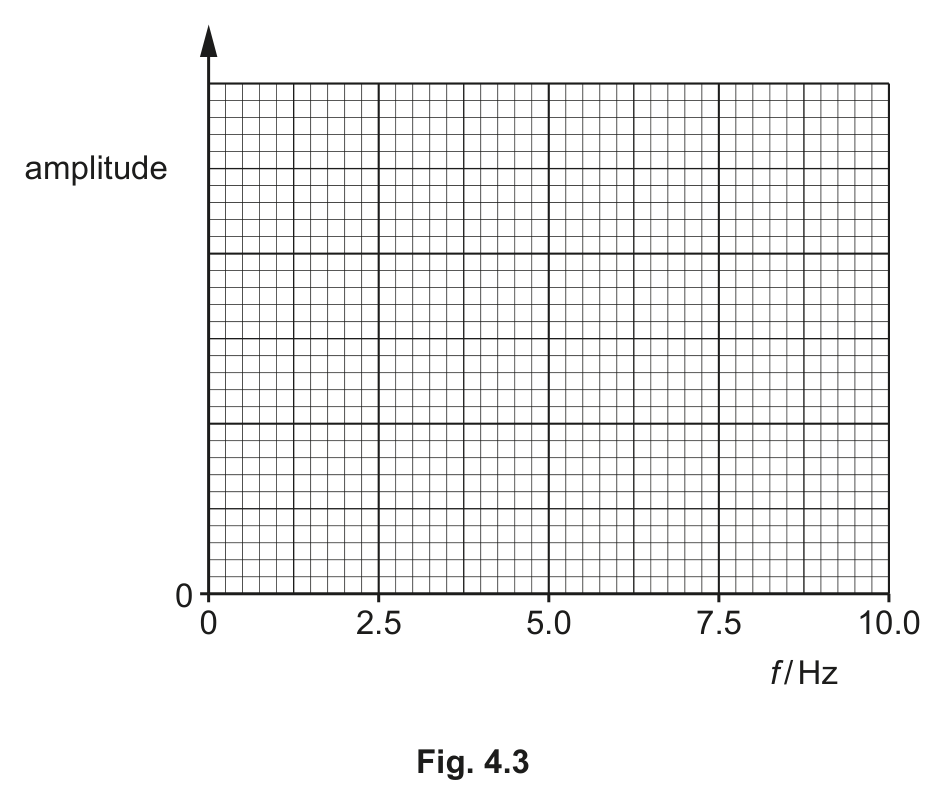
A small ball is held in place by a stretched string, one end fixed to a wall and the other attached to a vibration generator. The natural frequency of the ball's oscillations is that found from its free oscillations (about 3.7 Hz). The vibration generator is switched on and its frequency f of vibration is gradually increased from 0 to 10 Hz.
On Fig. 4.3, sketch the variation with f of the amplitude of the oscillations of the ball.
Your answer
Suggested time: 3 min
9702/41/M/J/24Cambridge International AS & A Level Physics 9702 · May/June 2024 · Paper 4 variant 1 · sit the whole paper