Showing every subjectChange subjects

9702/02/SP/22 · question 1 of 1 in this topic

Question 5

5(a)1 mark

A beam of vertically polarised monochromatic light is incident on a polarising filter, as shown in Fig. 5.1.

The transmission axis of the filter is initially vertical and the transmitted light beam has the same intensity as the incident light beam. The filter may be rotated about the direction of the light beam to change the angle of the transmission axis to the vertical.

State one angle of the transmission axis to the vertical that results in no transmitted light beam.
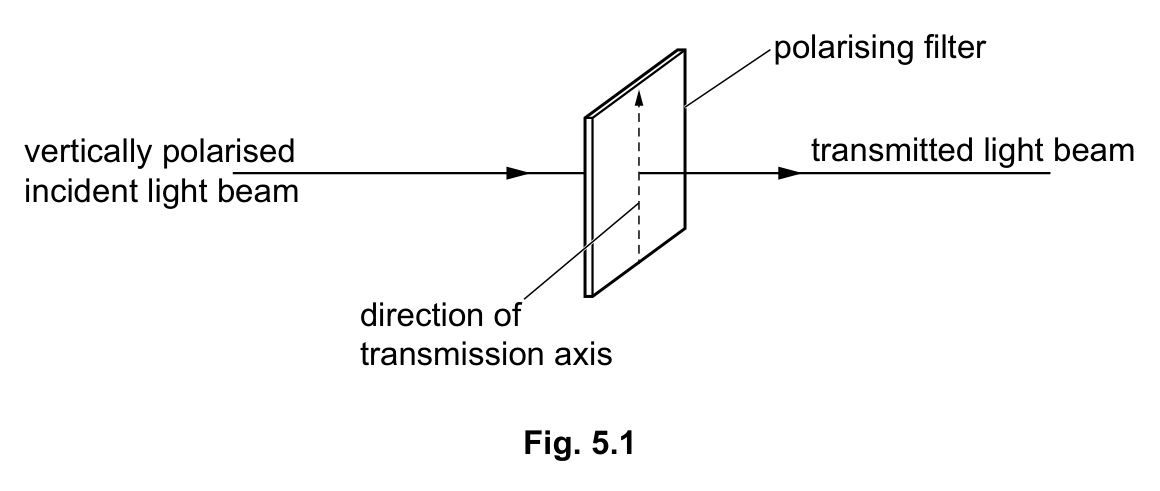
Fig. 5.1 — see the question text for what it shows

State A short answer. No explanation is needed, and adding one cannot earn extra marks.

Your answer

Suggested time: 2 min
5(b)(i)2 marks

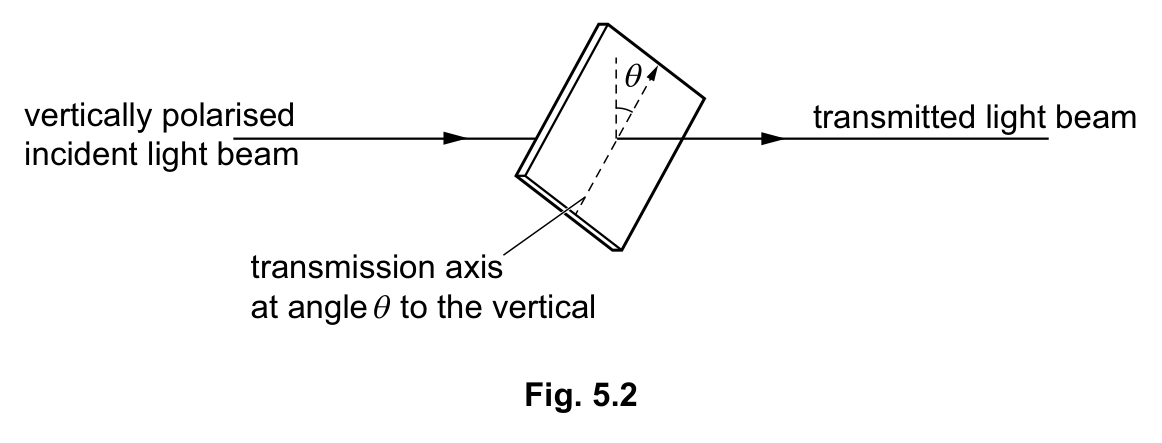
A beam of vertically polarised monochromatic light is incident on a polarising filter. When the transmission axis is vertical, the transmitted beam has the same intensity as the incident beam. The filter is now positioned with its transmission axis at angle θ to the vertical, as shown in Fig. 5.2.

The ratio (intensity of transmitted light)/(intensity of incident light) is equal to 0.75.

Calculate angle θ.

Fig. 5.2 — see the question text for what it shows

Calculate Show your working. The method can earn marks even when the final value is wrong, and a bare answer often cannot.

Your answer

Suggested time: 3 min

5(b)(ii)2 marks

A beam of vertically polarised monochromatic light passes through a polarising filter whose transmission axis is at angle θ to the vertical. The ratio (intensity of transmitted light)/(intensity of incident light) is equal to 0.75.

Calculate the ratio (amplitude of transmitted light)/(amplitude of incident light).

Calculate Show your working. The method can earn marks even when the final value is wrong, and a bare answer often cannot.

Your answer

Suggested time: 3 min

9702/02/SP/22Cambridge International AS & A Level Physics 9702 · Specimen 2022 · Paper 2 · sit the whole paper