Define force.
Your answer
Suggested time: 2 min
9702/02/SP/22 · question 2 of 2 in this topic
Define force.
Your answer
Suggested time: 2 min
State what is meant by work done.
State A short answer. No explanation is needed, and adding one cannot earn extra marks.
Your answer
Suggested time: 2 min
A block of mass 0.40 kg slides in a straight line with a constant speed of 0.30 m s⁻¹ along a horizontal surface, as shown in Fig. 3.1.
Assume that there are no resistive forces opposing the motion of the block. The block hits a spring and decelerates. The speed of the block becomes zero when the compression of the spring is 8.0 cm.
Calculate the initial kinetic energy of the block.
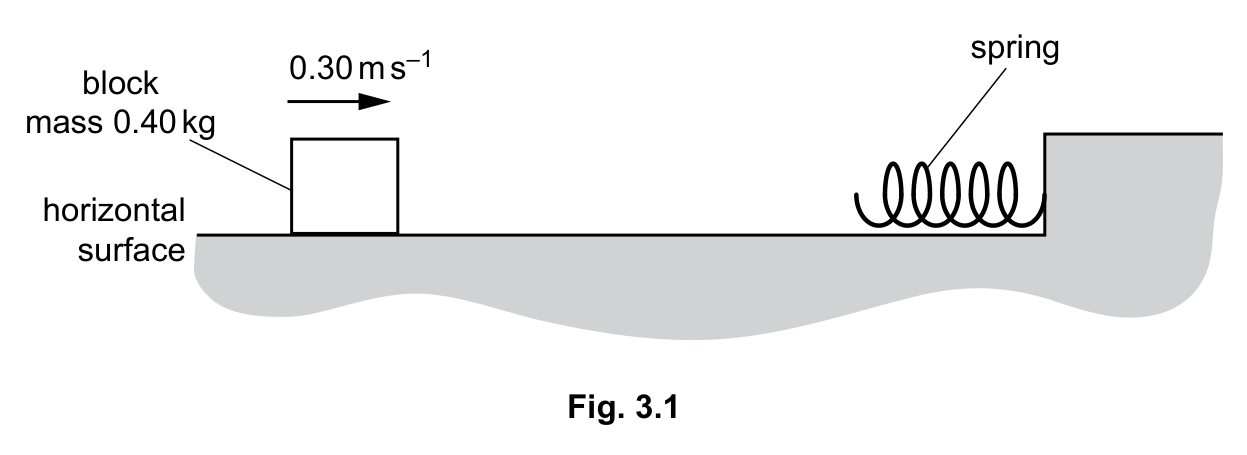
Calculate Show your working. The method can earn marks even when the final value is wrong, and a bare answer often cannot.
Your answer
Suggested time: 3 min
A block of mass 0.40 kg slides at 0.30 m s⁻¹ along a horizontal surface and hits a spring; the speed of the block becomes zero when the compression of the spring is 8.0 cm.
The variation of the compression x of the spring with the force F applied to the spring is shown in Fig. 3.2.
Assume that the elastic potential energy of the spring when its compression is 8.0 cm is equal to the initial kinetic energy of the block.
Use your answer in (b)(i) (the initial kinetic energy) to calculate the maximum force F_MAX exerted on the spring by the block.
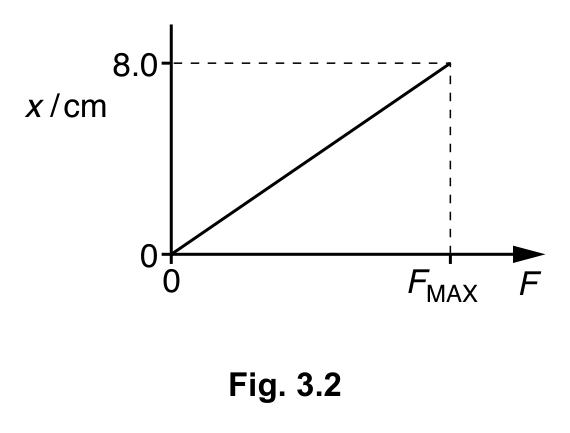
Using You must use the thing it names. An answer that reaches the right value another way may not score.
Your answer
Suggested time: 3 min
A block of mass 0.40 kg compresses a spring, and the maximum force exerted on the spring by the block is F_MAX (found in (b)(ii)).
Calculate the maximum deceleration of the block.
Calculate Show your working. The method can earn marks even when the final value is wrong, and a bare answer often cannot.
Your answer
Suggested time: 3 min
A block of mass 0.40 kg slides with constant speed 0.30 m s⁻¹ along a horizontal surface with no resistive forces, then hits a spring and decelerates until its speed becomes zero at a compression of 8.0 cm.
State and explain whether the block is in equilibrium:
• before it hits the spring
• when its speed becomes zero.
State A short answer. No explanation is needed, and adding one cannot earn extra marks.
Your answer
Suggested time: 3 min
A block of mass 0.40 kg slides along a horizontal surface towards a spring. The block is now replaced by another block of the same mass. Frictional forces affect the motion of this block so that it has a speed of 0.25 m s⁻¹ when it makes contact with the spring.
A short time later, the block has a speed of 0.15 m s⁻¹ as it loses contact with the spring and moves back along its original path.
Calculate the magnitude of the change in momentum of the block.
Calculate Show your working. The method can earn marks even when the final value is wrong, and a bare answer often cannot.
Your answer
Suggested time: 3 min
9702/02/SP/22Cambridge International AS & A Level Physics 9702 · Specimen 2022 · Paper 2 · sit the whole paper