By reference to the direction of transfer of energy, state what is meant by a transverse wave.
Your answer
Suggested time: 2 min
9702/02/SP/22 · question 2 of 2 in this topic
By reference to the direction of transfer of energy, state what is meant by a transverse wave.
Your answer
Suggested time: 2 min
State the principle of superposition.
State A short answer. No explanation is needed, and adding one cannot earn extra marks.
Your answer
Suggested time: 3 min
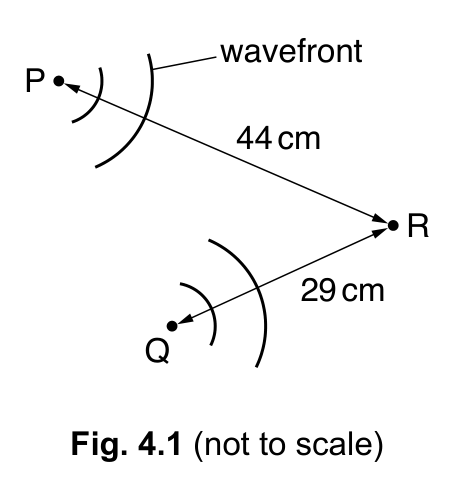
Circular water waves are produced by vibrating dippers at points P and Q, as illustrated in Fig. 4.1.
The waves from P alone have the same amplitude at point R as the waves from Q alone. Distance PR is 44 cm and distance QR is 29 cm.
The dippers vibrate in phase with a period of 1.5 s to produce waves of speed 4.0 cm s⁻¹.
Calculate the wavelength of the waves.
Calculate Show your working. The method can earn marks even when the final value is wrong, and a bare answer often cannot.
Your answer
Suggested time: 3 min
Circular water waves are produced by vibrating dippers at points P and Q vibrating in phase with a period of 1.5 s producing waves of speed 4.0 cm s⁻¹. Distance PR is 44 cm and distance QR is 29 cm.
Calculate the path difference at point R of the waves from P and Q. Give your answer in terms of the wavelength λ of the waves.
Calculate Show your working. The method can earn marks even when the final value is wrong, and a bare answer often cannot.
Your answer
Suggested time: 2 min
9702/02/SP/22Cambridge International AS & A Level Physics 9702 · Specimen 2022 · Paper 2 · sit the whole paper