Showing every subjectChange subjects

9702/21/M/J/24 · question 1 of 2 in this topic

Question 7

7(a)1 mark

Nuclei of an isotope of copper (Cu) each have 29 protons and 37 neutrons. This isotope is a β⁻ emitter.

State the nuclide notation in the form ᴬ_Z X for this nucleus of copper.

State A short answer. No explanation is needed, and adding one cannot earn extra marks.

Your answer

Suggested time: 2 min
7(b)(i)3 marks

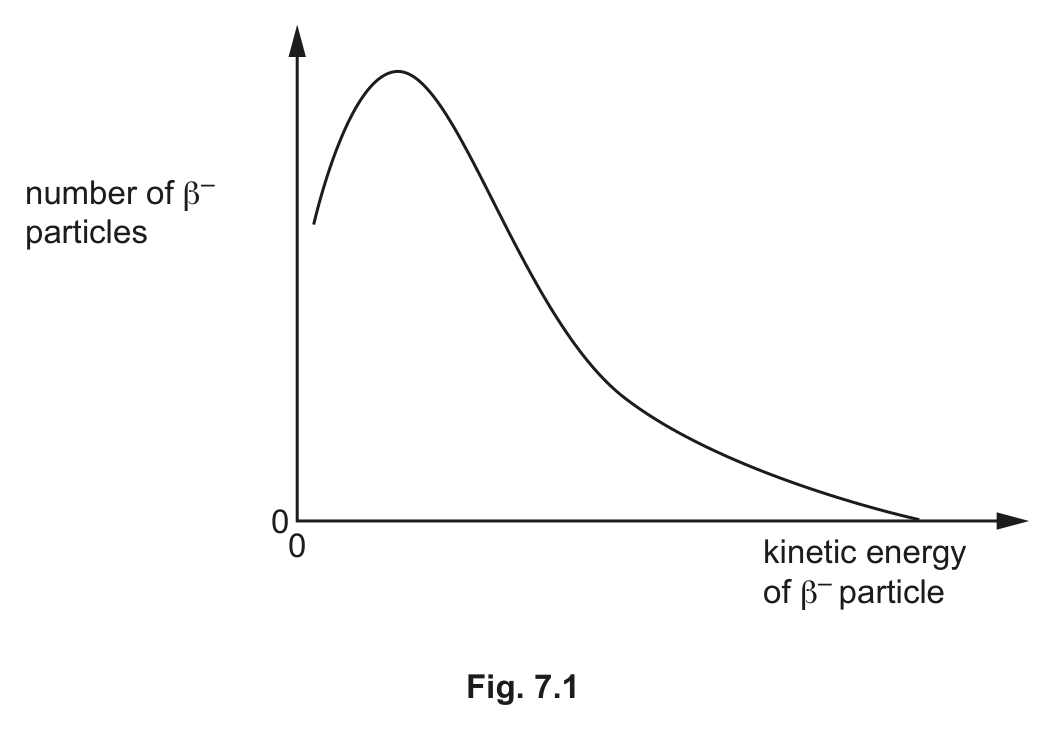
Nuclei of an isotope of copper (Cu) each have 29 protons and 37 neutrons; this isotope is a β⁻ emitter. The energy spectrum of the β⁻ radiation emitted by a sample of this isotope is shown in Fig. 7.1.

Use Fig. 7.1 to explain why other particles apart from the β⁻ particles must be emitted during this decay.

Fig. 7.1 — see the question text for what it shows

Using You must use the thing it names. An answer that reaches the right value another way may not score.

Your answer

Suggested time: 5 min

7(b)(ii)1 mark

An isotope of copper with 29 protons and 37 neutrons is a β⁻ emitter, and the β⁻ particles are emitted with a continuous range of kinetic energies.

State the name of the other particle emitted during the decay of this isotope.

State A short answer. No explanation is needed, and adding one cannot earn extra marks.

Your answer

Suggested time: 2 min

7(b)(iii)3 marks

An isotope of copper (Cu) whose nuclei each have 29 protons and 37 neutrons is a β⁻ emitter. The copper isotope decays to an isotope of zinc (Zn).

Give the radioactive decay equation for this decay. Include the nucleon and proton numbers of all the particles involved.

State A short answer. No explanation is needed, and adding one cannot earn extra marks.

Your answer

Suggested time: 5 min

9702/21/M/J/24Cambridge International AS & A Level Physics 9702 · May/June 2024 · Paper 2 variant 1 · sit the whole paper