Showing every subjectChange subjects

9702/41/M/J/24 · question 1 of 2 in this topic

Question 3

3(a)(ii)2 marks

Use one of the basic assumptions of the kinetic theory to explain what can be deduced about the potential energy associated with the random motion of molecules in an ideal gas.

Using You must use the thing it names. An answer that reaches the right value another way may not score.

Your answer

Suggested time: 3 min
3(b)(i)2 marks

A sample of 0.26 m³ of an ideal gas is at pressure 2.0 × 10⁵ Pa and temperature 290 K.

Determine the number N of molecules of the gas.

Determine Work it out from what you are given or from the figure, and show how you got there.

Your answer

Suggested time: 3 min

3(b)(ii)2 marks

A sample of 0.26 m³ of an ideal gas is at pressure 2.0 × 10⁵ Pa and temperature 290 K.

Determine the average translational kinetic energy E_K of one molecule of the gas.

Determine Work it out from what you are given or from the figure, and show how you got there.

Your answer

Suggested time: 3 min

3(b)(iii)2 marks

A sample of 0.26 m³ of an ideal gas is at pressure 2.0 × 10⁵ Pa and temperature 290 K.

Determine the internal energy of the gas. Explain your reasoning.

Explain Give reasons, not just what happens. Each distinct reason is usually worth a mark.

Your answer

Suggested time: 3 min

3(c)2 marks

A sample of 0.26 m³ of an ideal gas is at pressure 2.0 × 10⁵ Pa and temperature 290 K. The volume V of this gas is now varied, keeping its pressure constant.

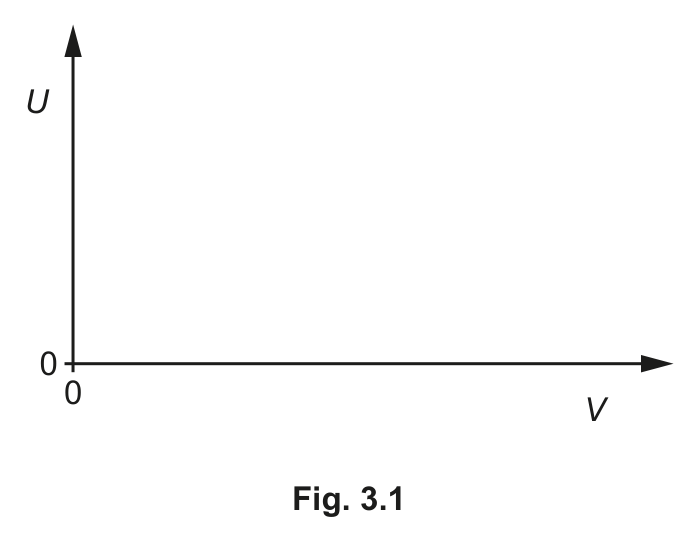
On Fig. 3.1, sketch the variation with V of the internal energy U of the gas.

Fig. 3.1 — see the question text for what it shows

Your answer

Suggested time: 3 min

9702/41/M/J/24Cambridge International AS & A Level Physics 9702 · May/June 2024 · Paper 4 variant 1 · sit the whole paper

LetStudy — Cambridge exam practice